
We’re back with our series of articles on clearing the verbal mayhem that is modern board gaming jargon. I’m trying to keep the list in as roughly an alphabetical order as I can to make it easy to find your favourite confusing term. This is part 6, so I’ve provided links to all nine parts below.
Mechanic
In broad terms, a board game mechanic is any part of the game that makes the game go: it’s essentially the set of rules describing game systems and the player actions that drive these systems. The term is used here in the same sense as “quantum mechanics”, and not as the noun that describes the person who repairs your car.
From a psychological perspective, naming a mechanic enables players to shortcut the entire mental connection to the game’s systems and create a mental schema of what actions are needed to proceed through the game. For example, when I say a game is “a deckbuilder” (q.v.) or uses a “deckbuilding mechanic”, then players know they will be using a set of cards in a particular way. The meta-information that players can derive from mechanic names is much larger than one would initially suspect, and can create a far greater impression of how a game plays out than a long-winded description from the publisher. Sometimes the listed combinations of mechanics can be more enthralling to experienced players than the marketing blurb.
One will also often see the term “…with a twist” added to a stated mechanic, meaning that players can expect an unexpected way of thinking about or manipulating that particular set of actions. For example, Viticulture was termed “worker placement with a twist” because the larger “grande” meeple (q.v.) slightly subverts the way standard worker placement (q.v.) games behaved (i.e. it subverts the action-blocking behaviour that is standard fare in worker placement games).
:strip_icc()/pic5146864.png "Click to enlarge")
That’s also why the game often feels unbalanced or confusing.
Meeple
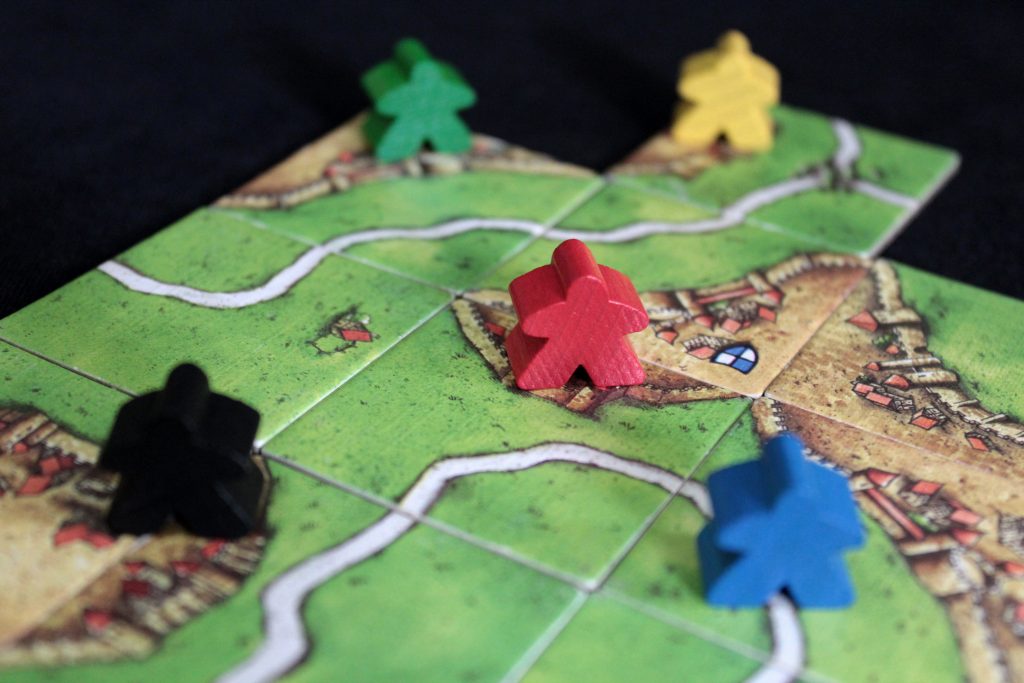
A meeple is the term for a vaguely human-shaped wooden token used in board games. The term was coined way back in 2000 when Alison Hansel, while playing a game of Carcassonne, confabulated “my” and “people”. Although the meeples from Carcassonne are the most well-recognized meeples, any similar-looking piece is still termed a meeple.
Minis
Mini is short for “miniature figurine”, and describes a moulded plastic figure used in gaming, distinct from wooden meeples. For many games that have them, minis are a deluxe add-on because the extra cost associated with producing and shipping the minis can make a game prohibitively expensive.

Scythe comes standard with minis, while Anachrony standard edition includes cardboard tokens and offers an “exosuit upgrade” pack to players who want to pay more for the admittedly cool-looking plastic figures.
Most minis come fresh from the factory in an unpainted state, and many gamers are content to leave the figures in that state. Others prefer to paint their minis. There is also an entire cottage-industry around people who offer mini-painting services to those who feel less artistically inclined, or who may not want to peek down the deep hobby-hole that is mini painting.
Despite the term, minis can get surprisingly large. Cthulhu Wars, for example, comes with a large assortment of very big figurines that look impressive on any table.
:strip_icc()/pic3163924.jpg "Click to enlarge")
Minmaxing
The term minmaxing originates from traditional paper RPGs where a player carefully customises a given character for a specific playthrough or scenario, assigning many values to very few statistics instead of evenly distributing the values to create a more balanced (or “realistic”) experience.
In board gaming, it has evolved to be a pejorative term that describes the behaviour of a player who puts the emphasis on squeezing every last possible point out of a set of actions. Wanting to score well isn’t a bad thing, but it becomes a problem when it creates a chokehold in the flow of a game, or when a player does this at the expense of fun or at the expense of acknowledging the game’s theme or ambience.
Multiplayer solitaire
Some games have so little direct player interaction that they’re termed multiplayer solitaire. This is often used to describe games where multiple people ostensibly play a game with each other but a single player could just as easily play alone with the same effect. The only satisfying interaction between players is the end-of-game scoring. This isn’t a bad or a good thing; most typical Euro-style games fall into this category and many players enjoy the puzzle of trying to optimise their own play area to score well.
Uwe Rosenberg is well-known for creating this style of game, and yet despite the seemingly negative connotation of the term, games such as Caverna and A Feast For Odin are still very popular.
:strip_icc()/pic3146943.png "Click to enlarge")
Narrative game
A narrative game has an overarching storyline that develops and grows as players proceed through the game; this means more than just a short paragraph at the front of the rulebook that explains the setting and theme. Often, players’ actions influence the narrative. Some narrative games have a flimsy, painted-on story, and the story doesn’t influence either the gameplay or future games; others have wildly-growing, branching narrative structures. It is an important concept that for a narrative game the players don’t create the narrative like they would in a role-playing game; instead, they are playing through one provided by the game designer.
Gloomhaven by Isaac Childres is one example of a narrative game. As the players proceed through the game and expand on the setting, new story twists and narrative elements are brought to light, but the story is still secondary to the dungeon crawling (q.v.) elements.

Another example that focuses more on the story would be Sleeping Gods by Ryan Laukat, which sees players exploring an archipelago. The board game is presented as an atlas, and the locations on the map have numbered sections which correspond to story paragraphs that players read out from an accompanying book. Sleeping Gods has so much content that you can play the game several times over and still not experience everything it has to show you, and includes multiple endings with this very scenario in mind.
Out of play
Components that are said to be out of play have left the game completely, and may not be interacted except under special circumstances. This is different from game components that were never in the game to start with, but that could potentially have been selected during game setup; these are usually forbidden from entering play under any circumstances whatsoever. It is common for designers to send cards and pieces out of play because they provide one-off abilities and actions that are too powerful and game-breaking to let players use repeatedly, or because players have somehow lost control of a component. Some legacy games (q.v.) further enforce this by instructing players to tear up cards, enforcing the sense of loss attached to those cards.
:strip_icc()/pic2452831.png "Click to enlarge")
Pandemic system
You know you’ve made it as a board game designer when your entire game engine is reused and repurposed for other games, and this is what’s essentially happened with Pandemic’s core game design. To sum up: the original Pandemic is a co-operative game (q.v.) where players work together to find cures for four viruses, failing which everyone loses the game. The genius of the Pandemic system is that cities that were previously hit by viruses get knocked again and again as outbreaks occur.
The system was repurposed for the game Forbidden Island two years later, and instead of cities being made vulnerable to viruses, now it was parts of the island sinking unless players could shore up those bits of the island first.
Pandemic’s publisher (q.v.) Z-Man Games released several other games bearing the “Pandemic” title, including Pandemic: Reign of Cthulhu, Pandemic: Rising Tide, and Pandemic: Fall of Rome, none of which had curing medical ails as their theme, but rather re-used the Pandemic system in some way or another.
:strip_icc()/pic2866737.png "Click to enlarge")
Party
A group of player characters involved in a dungeon crawl (q.v.) comprise a party, and this term is often found in rulebooks as a shorthand to mean the entire team. This term is seldom found outside of dungeon crawlers and narrative games (q.v.) and specifically means that the group has a single goal and wins or loses as a single entity. The players in Clank, for example, aren’t a party, because each player acts to their own benefit, even though the characters are involved in a dungeon crawl. The players in Gloomhaven and Sleeping Gods, however, are definitely a party.
:strip_icc()/pic5975244.png "Click to enlarge")
Party game
A party game is not one in which you find a party (q.v.) of characters, but instead refers to a type of game that is appropriate for a larger gathering of people. These games are usually short (although some can take several hours to play), and they need to be able to accommodate a larger number of players, usually up to eight or twelve (although games exist that can handle even larger numbers of players). Many party games require that players figure out hidden roles that other players hold (see social deduction game), and this sort of game works best in large groups.
:strip_icc()/pic1809823.jpg "Click to enlarge")
Pick-up and deliver
A pick-up-and-deliver mechanic, usually combined with the point-to-point movement (q.v.) mechanic, involves players collecting resources from one section of the play area and delivering them to another section. Importantly, players are usually awarded points or other rewards for doing so.
Some games, such as Mint Delivery and Istanbul, have this as almost their entire mechanic (q.v.), while others, such as Horrified, use it amongst a number of other mechanics.
:strip_icc()/pic6306248.jpg "Click to enlarge")


9 thoughts on “Board Game Jargon Primer, Part 6”